Better ball handling comes from daily, deliberate repetition of a few core moves: fingertip control, pound dribbles, a low stance, and game-like drills. The skill matters early because only about 3.6% of high school boys reach any NCAA division, so the players who protect the ball and create offense earn the minutes that build a real basketball future.
Last updated: June 2026
Key Takeaways
- Dribbling is the act of bouncing the ball; ball handling is how a player uses that dribble to change speed, change direction, and protect possession.
- Four habits drive improvement: fingertip control, hard pound dribbles, a low athletic stance, and consistent repetition.
- Practicing with the head up and visualizing defenders turns driveway reps into game-ready control.
- Strong handles mean fewer turnovers, more scoring chances, and more trust from coaches at every level.
- Daily practice of 15 to 20 minutes beats occasional long sessions for building muscle memory.
Plenty of young players dream about crossovers and highlight dunks. The work that actually earns playing time starts lower to the ground, with the ball on a string and the head up. Ball handling is the first skill that separates a player who can be trusted with the ball from one who watches from the bench. The good news for parents: it is also the skill a child can practice almost anywhere, with nothing but a ball and a flat surface.
This guide breaks down what ball handling actually is, the techniques that improve it fastest, and how to help your child build a routine that sticks.
What is the difference between dribbling and ball handling?
The two terms get used interchangeably, but they describe different things, and understanding the gap helps a player practice with purpose.
| Dribbling | Ball Handling |
|---|---|
| The physical act of bouncing the ball with one hand | How a player uses the dribble in a live game |
| Focuses on touch, rhythm, and control of the bounce | Focuses on changing speed and direction, protecting the ball, and reading defenders |
| Practiced in isolation with drills and reps | Applied under pressure against traps, double teams, and fast breaks |
Because every ball-handling move is built on a clean dribble, improving the dribble automatically improves overall control. But a player who only practices dribbling without picturing real game situations will look smooth in the driveway and lose the ball in a game. The goal is to connect technique with imagination.
What are the best ball handling techniques to practice?
Four techniques produce the fastest improvement. Each one can be practiced at home, and none of them require fancy equipment.
1. Fingertip control
Control the ball with the finger pads, not the palm, the same way the hand works on a shot. Fingertip control returns the ball to the hand faster and makes pull-ups, drives, and passes sharper. A player who learns to feel the ball on the fingertips early rarely has to relearn it later.
2. Pound dribbles
Pounding the ball hard into the floor builds hand strength and a quicker, more reliable dribble. A simple drill: 30 hard right-hand pounds, then 30 with the left, all without looking down. Keeping the head up is the entire point. It trains a player to see the floor and make decisions while the ball takes care of itself.
3. Low athletic stance
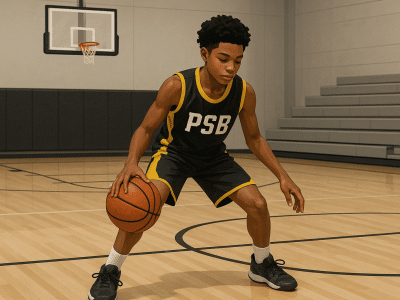
Bent knees and a lower center of gravity shorten the distance the ball travels, which makes it far harder to steal. A low stance also keeps a player balanced and ready to explode in any direction. Most turnovers at the youth level come from standing too tall.
4. Repetition and routine
Practice does not make perfect; practice makes permanent. Hundreds of crossovers, between-the-legs, and behind-the-back reps turn deliberate moves into automatic ones. Short, focused sessions every day build muscle memory faster than one long session on the weekend. A few of our favorite at-home patterns appear in our solo and partner drill guide for middle school players.
5. Imagination drills
Set up cones and treat each one as a defender. Dribble through the pattern, then explode into a jump shot or a pass. Visualizing pick-and-rolls, traps, and fast breaks while practicing is what turns a clean dribble into usable ball handling. The same principle of training focus under pressure carries into games, something we cover in how to improve basketball concentration.
“Because I never get bored with the basics.”
— Kobe Bryant, when asked why he still drilled fundamentals as the best player in the world

Why do strong handles mean more playing time?
Coaches at the middle school, high school, and college levels all value the same thing: a player they can trust with the ball when the pressure is on. Better ball handling pays off in three concrete ways.
- Fewer turnovers. A player who protects the ball keeps possessions alive and keeps the coach calm. Turnovers are the fastest way to lose minutes.
- More offense. Solid handles let a player drive to the rim, kick out to an open teammate, or pull up for a shot. Control creates options.
- More confidence. A player who trusts their handle plays faster, makes braver decisions, and lifts the players around them.
This matters more than most families realize. Roughly 3.6% of high school boys basketball players go on to compete at any NCAA division, and only about 1.1% reach Division I, according to the NCAA’s 2024-25 estimates. Ball handling is one of the few skills a child can improve every single day without a team, a gym, or a coach present, which makes it one of the highest-return habits a young player can build. Families thinking further down the road can see what that path looks like in our overview of how to play basketball in college.
How does Pro Skills Basketball teach ball handling?
Our approach is straightforward, and it still produces modern results. Coaches break every drill into teachable steps so each player understands the reason behind the movement, not just the motion. In our small-group sessions, players rotate through skill stations covering ball handling, shooting, footwork, and conditioning, which keeps them engaged while maximizing touches.
For families who want a fuller development environment, our camps and clinics pair a fundamentals block in the morning with scrimmages in the afternoon so players apply what they practiced. Club teams add year-round competition for those ready for a serious commitment. Whatever the level, the habits a player builds, discipline, focus, and persistence, carry well beyond the court.
Frequently Asked Questions
How long should a young player practice ball handling each day?
Fifteen to twenty minutes of focused daily practice beats a single long weekend session. Short, consistent reps build the muscle memory that holds up in a game.
At what age should a child start working on ball handling?
As soon as a child can comfortably dribble, usually around ages 6 to 8, they can begin simple fingertip and pound-dribble work. Keep it playful at first and add structure as coordination develops.
Why should a player keep their head up while dribbling?
Dribbling with the head up trains a player to read the floor, spot open teammates, and react to defenders. A player staring at the ball cannot make a basketball play.
Do ball-handling drills really help a child get more playing time?
Yes. Coaches give minutes to players who protect the ball and create offense. Fewer turnovers and more confident decisions directly earn trust, and trust earns minutes.
What equipment does my child need to practice at home?
A properly sized basketball and a flat surface are enough to start. A few cones or even water bottles can stand in for defenders during imagination drills.
Sources

 10 Ways to Prevent Youth Sports Injuries