Key takeaways: The five youth basketball drills that consistently produce results are form shooting, two-ball dribbling, the George Mikan finishing drill, wall passing, and one-on-one. Together they build shooting mechanics, weak-hand skill, finishing, passing, and decision-making under pressure. A sample workout takes 25 minutes. Do it 3 to 4 times per week.
The five basketball drills that consistently produce results for youth players are form shooting, two-ball dribbling, the George Mikan finishing drill, wall passing, and one-on-one. These are not complicated. They are the fundamentals that coaches at every level return to because they work.
Repetition of the right movement patterns builds the muscle memory that holds up under game pressure. This guide breaks down each drill and explains what it actually develops. It also shows how to build a practice routine around them.
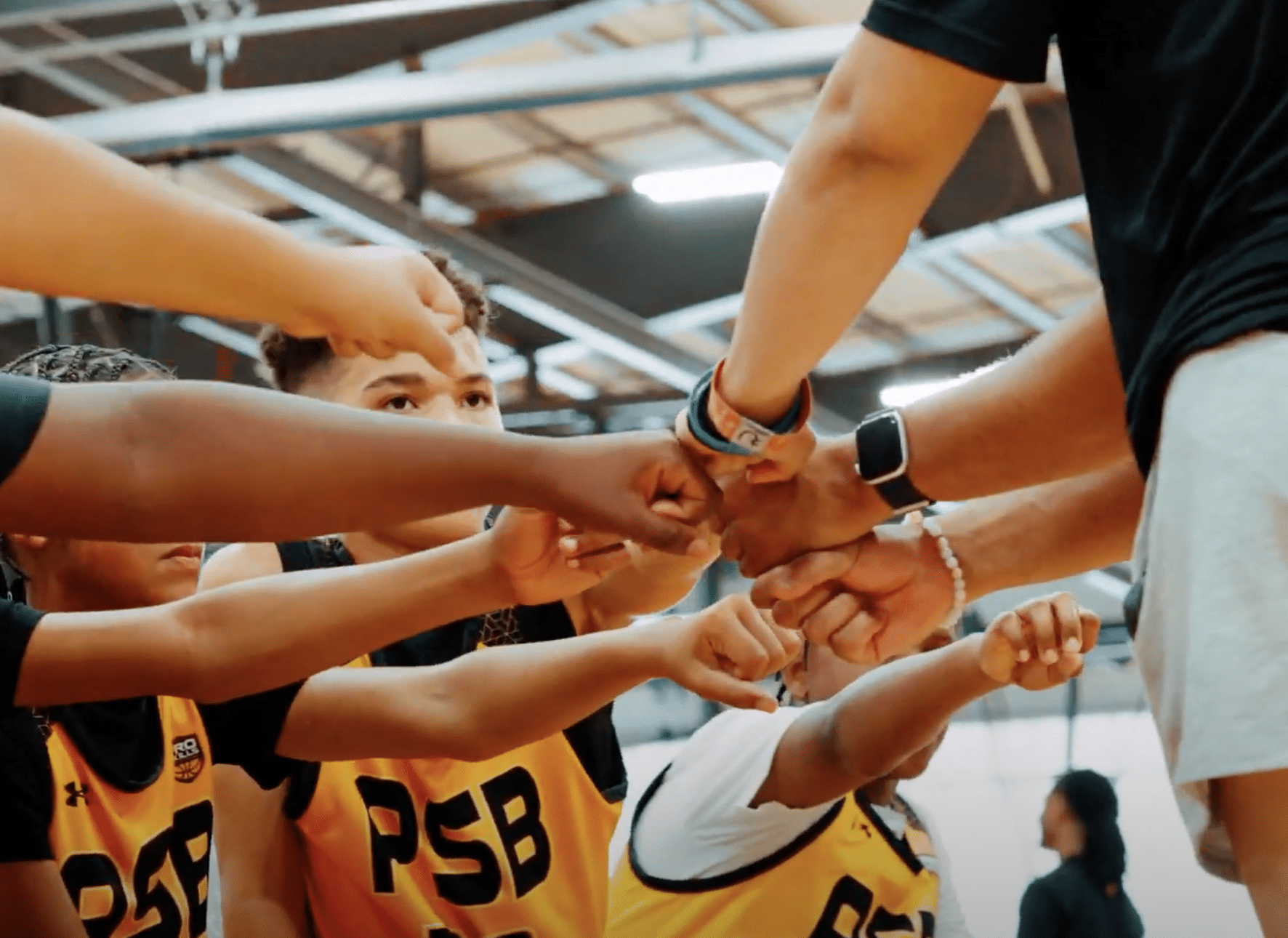
At Pro Skills Basketball, we build these fundamentals into every practice. Our USA Basketball certified coaches work with players in grades 1-12 across 28 cities nationwide. PSB is a Jr. NBA Flagship Network organization, designated as one of the top 15 best-in-class youth basketball organizations in the country. Here’s what we know produces real skill development in young players.
Last updated: June 2026
Basketball remains the most popular team sport among U.S. youth, with roughly 1 in 4 children ages 6-17 playing it, according to the Aspen Institute’s Project Play State of Play 2024 report. (source)
1. Form Shooting: Build the Mechanics That Don’t Break Down
Form shooting is the foundation of every reliable shooter. The drill is simple: stand close to the basket (3-5 feet), focus entirely on mechanics, and shoot at slow speed with full attention to every detail.
The mechanics to build:
- Shooting hand under the ball, guide hand on the side only (not controlling the shot)
- Elbow in, aligned under the ball
- Legs loading into the shot, not just arm strength
- Full follow-through, wrist snapping forward on release
- Eyes on the target before, during, and after release
Progression: Start at the block with 10 makes. Move back to the elbow. Then to the wing. The drill stays form-focused at each distance. Never rush to game distance before the mechanics at the closer range are clean. For more on building a reliable shot, see PSB’s two-hand form shooting guide.
The most common form shooting mistake young players make is rushing through it. They go through the motions at speed instead of slowing down to engrain correct movement. Slow, perfect reps build muscle memory faster than fast, sloppy reps.
2. Two-Ball Dribbling: Build Handles That Work Without Looking
Two-ball dribbling forces a player to develop a feel for the ball that single-ball work can’t replicate. When both hands have to work simultaneously, the weaker hand gets no rest and has to develop quickly.
Basic two-ball dribbling variations:
- Simultaneous: Both balls hit the floor at the same time. Start here.
- Alternating: One ball hits as the other comes up. Harder coordination than simultaneous.
- High-low: One hand dribbles at waist height, the other at ankle height simultaneously.
- Walking variations: Dribble both balls while walking the length of the court.
What to look for: Players should be able to maintain both dribbles without looking at the balls within the first few weeks of practice. If they’re constantly looking down, the drill is working. Just not done yet. Eyes-up dribbling is the goal. Keep going until it’s automatic.
3. The George Mikan Drill: Finish at the Rim from Both Sides
The Mikan drill is named after Hall of Fame center George Mikan and has been teaching finishing around the rim for over 70 years. It works the same now as it did then.
How it works:
- Stand directly under the basket.
- Lay the ball in off the backboard from the right side, using the right hand.
- Catch the ball before it hits the floor, immediately take one step left, and lay it in from the left side using the left hand.
- Continue back and forth without stopping for 30-60 seconds.
The drill builds the footwork, touch, and ambidexterity to finish close-range shots with either hand. It also builds conditioning. Non-stop Mikan reps at full effort for a minute is more physically demanding than it looks.
Progression: Once the basic version is clean, add a reverse layup variation: using the backboard on the far side of the basket for the reverse finish. This is the finish most youth players miss most often in games.
4. Wall Passing: Build Passing Accuracy and Hand Strength
Wall passing is underrated because it looks too simple. It isn’t. Chest passes, bounce passes, and overhead passes thrown accurately and repeatedly against a wall build the hand strength, timing, and accuracy that show up in games.
How to run it:
- Stand 6-8 feet from a solid wall
- Chest pass: Both hands release simultaneously, stepped into with the front foot, aimed at a target on the wall
- Bounce pass: Aimed so the ball hits the floor about two-thirds of the distance to the wall and returns at a catchable height
- Overhead pass: Both hands above the head, snapping the wrists on release
Set a target (tape an X on the wall) and work toward hitting it consistently for 30 passes per variation before moving on. This forces accuracy, not just volume.
5. One-on-One: Apply Everything in Live Competition
The first four drills build skills in controlled conditions. One-on-one is where those skills get tested under pressure. It is the closest to game conditions a player can get in a small-group or individual workout.
One-on-one rules that maximize development:
- Allow only one dribble to start, then advance to two, then live. This forces footwork and decision-making before adding ball movement.
- Play from multiple spots: elbow, wing, short corner, top of the key. Each position creates different reads.
- Require the offensive player to call their shot before catching (“left elbow jumper”) to force intentional decision-making
One-on-one doesn’t mean full contact or reckless competition. It means contested situations where the offensive player has to solve a real defensive problem with the skills they’ve been developing. The defender should make the offensive player work without fouling.
Bonus Drill: Defensive Closeout
Most drill guides focus on offense. This one is worth adding because the closeout is one of the most fundamental and most broken defensive skills in youth basketball. Players who can close out correctly guard shooters and put pressure on the ball. Players who can’t give up open catch-and-shoot looks all game.
How it works:
- Start under the basket.
- A partner or coach stands at the three-point line with a ball.
- The defender sprints to close the gap, taking short choppy steps as they approach to avoid getting blown by.
- Hands are active and up, contesting without fouling.
- The attacker decides to shoot or drive. The defender reacts correctly to both.
The mistake most players make on closeouts is sprinting at full speed all the way to the shooter, making themselves easy to blow by. The fix is full sprint, then chop steps in the last few feet. It’s teachable and shows up in games immediately after players learn it.
How to Build a Practice Routine with These Drills
Knowing the drills is step one. Using them consistently is what actually produces results. Here’s a sample 25-minute individual workout:
- 0:00-5:00, Two-ball dribbling: Simultaneous, alternating, high-low. Eyes up the whole time.
- 5:00-10:00, Form shooting: Start at the block. Work to elbow, then wing. 10 makes at each spot before moving.
- 10:00-14:00, Mikan drill: 4 sets of 45 seconds. 15 seconds rest between sets. Add reverse on the last two sets.
- 14:00-18:00, Wall passing: Chest pass, bounce pass, overhead pass. 30 reps each with a target on the wall.
- 18:00-25:00, One-on-one: With a partner from 3 spots. One dribble limit first, then live.
Do this 3-4 times per week. Consistency over time matters more than intensity in a single session. Players who follow this routine 3 days a week for a full season will look noticeably different at tryouts than players who skip individual work entirely.
For structured training with certified coaching built in, explore PSB camps and clinics and the PSB online training library.
Spring season is underway and PSB teams are open across the country. Work with USA Basketball certified coaches in a structured development program.
“Hunter was never handed anything. He was a good player, sure, but what set him apart was how much better he got every single year because he showed up and did the work.”
— Brendan Winters, PSB co-founder
Using the right size ball? Players build better form with a ball that fits. See our basketball size chart by age and grade.
Frequently Asked Questions About Basketball Drills for Youth Players
How often should youth players practice basketball drills?
3-4 individual skill sessions per week is a strong target for players who want to see measurable improvement. Sessions don’t need to be long. 20-30 focused minutes is more valuable than an hour of unfocused repetition. Consistency over weeks and months matters more than any single workout.
What basketball drills are best for beginners?
Form shooting and wall passing are the best starting points for beginning players because they can be done without a partner and directly build foundational mechanics. Two-ball dribbling is a close third. It quickly reveals which hand is weaker and forces both hands to develop. These three alone, done consistently, produce visible improvement within 2-3 weeks.
Can these drills be done at home without a gym?
Yes. Wall passing requires nothing but a ball and a solid wall. Two-ball dribbling can be done on any flat surface with two balls. Form shooting needs a hoop, but many neighborhoods have accessible outdoor courts. The Mikan drill and one-on-one require a hoop and a partner, but the other three drills are solo and location-independent.
How long does it take to see results from consistent basketball drill practice?
Most players notice improved feel and mechanics within 2-3 weeks of consistent practice. More visible skill development (stronger weak hand, more reliable shot, better passing accuracy) typically shows up after 6-8 weeks. Long-term improvement compounds over a full season of consistent work.
What’s the difference between good and bad basketball drill practice?
Good practice has intentional focus on mechanics, specific targets, and honest self-assessment of what’s working. Bad practice is going through the motions at speed without attention to quality. Slow, correct reps build muscle memory. Fast, sloppy reps build sloppy habits. A player who does 50 form-shot reps with full attention to mechanics improves faster than one doing 200 reps at speed thinking about something else.
Should youth players do basketball drills during the season?
Yes, but volume should adjust. During the season, 1-2 individual skill sessions per week is enough to maintain mechanics and keep skills sharp. The in-season focus is applying skills in competition, not building new ones from scratch. Off-season (spring and summer between seasons) is when the biggest individual skill development happens.
Sources

By Brendan Winters, Co-Founder and Chief Growth Officer
Brendan co-founded Pro Skills Basketball in 2009 and is its Chief Growth Officer. At Davidson College he was a two-time All-American and Southern Conference Player of the Year. He then played five pro seasons in France, Germany, Hungary and Greece.

 The 5-Minute Basketball Warm-Up for Youth Teams