
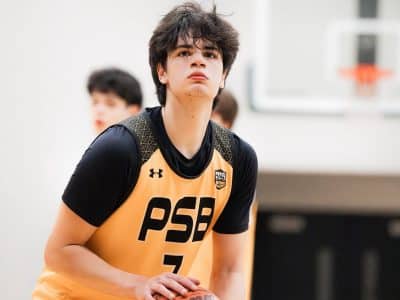
Two-hand form shooting teaches a young player to build a repeatable shot by adding the guide hand to the full shooting motion, close to the rim. With basketball drawing 540,704 boys at the high school level in 2024-25 (NFHS), clean mechanics are what keep a player on the floor as competition tightens.
Last updated: June 2026
Key Takeaways
- Two-hand form shooting is the bridge between pure technique and a live jump shot. It adds the guide hand without adding distance.
- The PSB formula is simple: Home Base, Sit, Lift, then Snap and Dip.
- Keep the work close to the rim. The goal is clean mechanics, not makes.
- A balanced base and an elbow that forms an “L” do more for accuracy than raw strength.
- Fifty deliberate form shots a session build the muscle memory that holds up under game pressure.
Shooting is the skill that earns playing time. A player who can put the ball in the basket gives a coach a reason to keep them on the floor, and that is true at every age and size. The good news for parents: a reliable shot is built, not inherited. It starts with form work done the right way.
I learned this the hard way. Growing up, I earned minutes because I could shoot, even though I was not the fastest or strongest player on the court. But my mechanics were inefficient. I was taught to start the ball high above my head and jump as high as I could on every attempt. It worked most of the time, but it was not repeatable, and it took far more reps than it should have. At Pro Skills Basketball we teach a simpler path, and it begins with one-hand and two-hand form shooting.
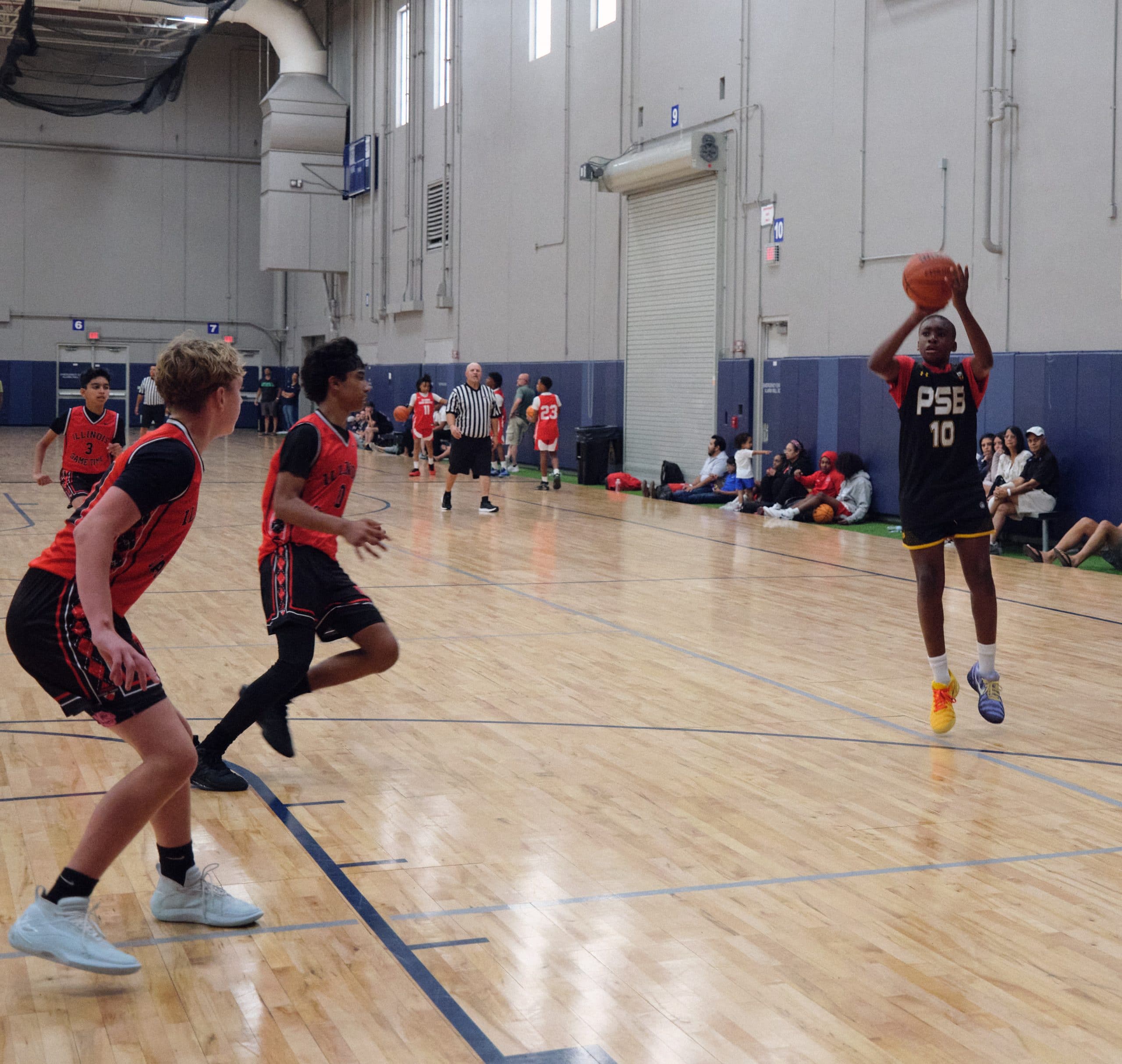
What is 2-hand form shooting?
Two-hand form shooting is a close-range drill where a player rehearses the complete shooting motion using both hands: the shooting hand under the ball and the guide hand on the side for support. Unlike one-hand form work, which isolates the shooting hand alone, the two-hand version simulates how the shot actually leaves the body in a game.
The point is to groove proper mechanics before range or defenders enter the picture. Standing a few feet from the rim, a young player can focus entirely on balance, hand position, and follow-through. That focus is what builds the muscle memory a real jump shot depends on. For more shot-building work you can do without a coach, see our guide to at-home basketball shooting workouts.
How do you teach the 2-hand form shot step by step?
We give players a short formula they can repeat out loud: Sit. Lift. Snap and Dip. Each phrase locks in one part of the motion. Here is how the full sequence breaks down.
Step 1 – Home Base
Every shot starts from the same setup. Consistency here makes everything that follows repeatable.
- Stand tall with toes, hips, and shoulders facing the rim
- Feet shoulder-width apart
- Shooting hand under the ball, fingers across the seams
- Guide hand on the side, not influencing the shot
- Ball resting on the finger pads, not buried in the palm
- Shooting elbow tucked in toward the hip
Step 2 – Sit
This loads the lower body, like easing back into a chair.
- Hips back, knees bent naturally
- Weight on the heels, not the toes
- Upper body stays tall
- Eyes locked on the rim
- Knees do not drift forward past the toes
This is where balance and power come from. A shot built from the ground up holds together when a player is tired late in a game.
Step 3 – Lift (to an “L”)
Now the upper body moves into shooting position.
- Ball lifts to the shooting pocket, between the shoulder and the top of the head
- Elbow stays under the ball to form an “L,” not a “V”
- Ball stays on the finger pads
- Index finger points slightly toward the face
- Guide hand supports the ball without pushing it
Step 4 – Snap and Dip
This is the release and follow-through, where everything ties together.
- Upper and lower body extend at the same time
- Guide hand comes off without rotating the ball
- Ball rolls off the index and middle fingers
- Shooting elbow snaps and locks
- Knees extend fully and the player finishes on the toes
- Fingers “dip” toward the rim on the follow-through
- Hold that follow-through until the ball hits the rim
How is 2-hand form shooting different from 1-hand?
Both drills live close to the basket and both train clean mechanics, but they serve different jobs. One-hand form work strips the motion down to the shooting hand alone so a player feels the ball roll off the fingertips. Two-hand work then reintroduces the guide hand and the lower-body load, getting the player closer to a real shot. Most young players progress from one to the other.
| Element | 1-Hand Form | 2-Hand Form |
|---|---|---|
| Hands used | Shooting hand only | Shooting hand plus guide hand |
| Main focus | Ball off the fingertips, wrist snap | Full motion with balance and lift |
| Lower body | Minimal, often stationary | Loads and extends with the shot |
| Best for | Brand-new shooters, isolating the hand | Bridging to a live jump shot |
What is a good 2-hand form shooting drill?
Here is a simple routine that works for players at any level:
- Start on the baseline, three to five feet from the rim
- Shoot 10 form shots slowly and deliberately
- Move to the wing at the same distance and shoot 10 more
- Repeat in front of the rim, the opposite wing, and the far baseline
- That is five spots times 10 reps, for 50 total form shots
- When finished, take one step back and run it again
Each shot should take five to ten seconds. The focus is technique, not the scoreboard. Once the form holds up close to the rim, a player can stretch the range while keeping the same motion. Our breakdown of shooting workouts to become a D1-level shooter shows how that progression continues as a player gets older.
“There’s one thing that all great shooters have in common, and that’s complete control over their mechanics. That’s not something you’re born with. You have to practice it.”
— Stephen Curry, MasterClass
Why does form shooting work?
Form shooting builds muscle memory. When a player rehearses the same clean motion hundreds of times in a low-pressure setting, the body learns to repeat it automatically, even when a defender closes out or the game speeds up. That is why we lean on these drills across our programs rather than chasing flashy fixes.
It also keeps bad habits from taking root. A young player who learns to shoot off balance or with the ball in the palm will fight that habit for years. Starting clean, close to the rim, is the most efficient path to a shot that lasts. If your player wants more structured reps, our skills clinics spend focused time on shooting mechanics.
Frequently Asked Questions
At what age should a young player start form shooting?
As soon as a player can comfortably get the ball to the rim with a smooth motion, usually around seven or eight, form shooting close to the basket is appropriate. Younger players may use a lowered hoop or a lighter ball so they are not heaving the shot.
How many form shots should my player take per session?
Fifty deliberate reps, spread across five spots near the rim, is a strong baseline. Quality matters far more than quantity here. Ten clean shots beat fifty rushed ones.
Should the guide hand ever touch the ball at release?
No. The guide hand supports the ball on the way up and comes off cleanly at release without turning or pushing. If the guide hand thumb flicks the ball, it sends the shot off line.
Will form shooting hurt my player’s shooting range?
The opposite. A player builds range by extending the legs and keeping the same motion, not by changing the shot. Clean form close in is what makes deeper shots possible later.
Is two-hand form shooting only for beginners?
No. Experienced shooters, including pros, return to form work to keep their mechanics sharp. It is a maintenance tool, not just a starting point.
Sources

By Brendan Winters, Co-Founder and Chief Growth Officer
Brendan co-founded Pro Skills Basketball in 2009 and is its Chief Growth Officer. At Davidson College he was a two-time All-American and Southern Conference Player of the Year. He then played five pro seasons in France, Germany, Hungary and Greece.

 How to 1-Hand Form Shoot a Basketball