
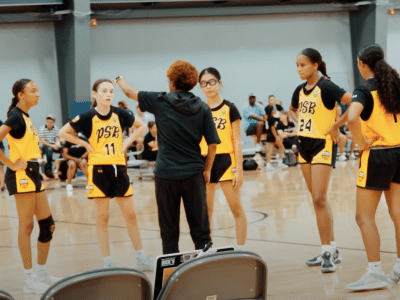
Your player is one of the best on their team, and a coach asks about moving them up a grade. Should they play up? It can help some players grow and hold others back. This guide covers the pros, the cons and the questions to ask first.
Quick answer: Playing up means playing in an older age group or grade than your player’s own. It can help a player who is clearly ahead in skill, size and confidence. It can hurt a player who will lose playing time, touches or confidence. The deciding question is usually simple: will your player still play real minutes and handle the ball?

Key Takeaways
- Playing up means playing in an older age group or grade
- It helps players who are clearly ahead and will still play real minutes
- Losing minutes and touches can slow development
- Most events allow playing up but not down
- Ask your player if they want it
What does playing up mean in youth basketball?
Playing up means a player joins a team in an older age group or grade, like a 5th grader on a 6th grade team. Most tournaments allow players to play up, but not down. See AAU basketball age groups for how divisions work.
What are the pros and cons of playing up?
| Possible pros | Possible cons |
|---|---|
| Tougher competition pushes growth | Fewer minutes and touches on the court |
| Faster, stronger players to learn from | Confidence can drop if they struggle |
| Can keep a talented player engaged | Friends and social fit are in their own grade |
| Prepares for the next level | Physical mismatch can raise injury risk |
Who should play up?
Playing up tends to work best for a player who is clearly ahead in skill, strong enough to compete physically, confident, and will still play real minutes with the ball in their hands. It tends to backfire when the move means sitting on the bench or standing in the corner. Players get better by playing, not by watching.
The NBA and USA Basketball youth guidelines also use different rules by age, such as game length and practice time, so an older team usually means a heavier schedule.
What should I ask before my player plays up?
- Will my player play real minutes, or mostly sit?
- Will they still handle the ball and make decisions?
- Are they ready physically and emotionally, not just in skill?
- Do they want to play up?
- Can they move back to their own grade if it does not work?
Where does PSB fit?
Where Pro Skills Basketball fits
Pro Skills Basketball (PSB) runs boys and girls club teams, often called AAU or travel teams, for grades 1 to 11 in 27 U.S. cities. PSB is one of 18 organizations in the Jr. NBA Flagship Network and a USA Basketball Official Youth Organization.
PSB teams practice 2 to 3 times a week with trained, background-checked coaches. Players join through spring tryouts, fall tryouts, or an evaluation at a team practice when a team has an open spot.
PSB coaches place players by grade and talk with families before any move to an older team.
Find teams for your player’s grade
More AAU guides for parents: What is AAU basketball? · How much AAU costs · What age to start · AAU vs club vs school vs rec · How to choose a team
Frequently Asked Questions
What does playing up mean in youth basketball?
It means playing in an older age group or grade than your own, for example a 5th grader playing on a 6th grade team.
Is it good for a player to play up an age group?
It can be, for a player who is clearly ahead and will still play real minutes. For others, losing minutes and touches can slow development.
Can AAU players play down an age group?
Usually not. Most events allow playing up to an older division, but not down.
Should my player play up or be the best on their own team?
It depends on minutes and touches. Being a leader on their own team can build skills and confidence just as well as playing up.
What age is playing up most common?
It is most common in elementary and middle school, when skill and size can vary a lot within one grade.
Who decides if a player plays up?
Usually the club and coaches with the family. Ask for the reason and a plan, and make sure your player wants it.
Sources

By Brendan Winters, Co-Founder
Brendan co-founded Pro Skills Basketball in 2009. At Davidson College he was a two-time All-American and Southern Conference Player of the Year. He then played five pro seasons in France, Germany, Hungary and Greece.

 My Player Didn’t Make the Basketball Team: What to Do Next
