
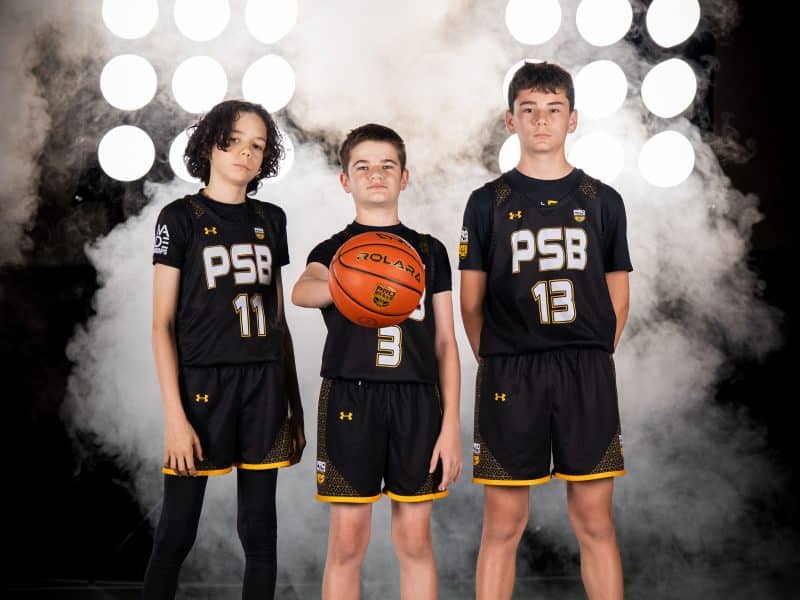
One-hand form shooting is a close-range drill that isolates a player’s shooting hand to build clean mechanics one rep at a time. Players start a few feet from the rim and move through four positions: Home Base, Sit, Lift, and Dip & Hold. With basketball the most-played youth team sport in America, a repeatable shot is one of the clearest ways to stand out.
Last updated: June 2026
I used form shooting through my entire career, from youth ball at home to playing professionally in Europe. It is the quiet work that locks in mechanics, builds confidence, and gets the body ready before practice. If your child wants to become a reliable shooter, this is where it begins. When Stephen Curry rebuilt his shot in high school, his father kept him shooting close to the rim for weeks, focused on nothing but form. The fundamentals come first.
Key Takeaways
- One-hand form shooting isolates the shooting hand so young players groove correct mechanics before adding the guide hand.
- The four positions are Home Base, Sit, Lift, and Dip & Hold, practiced slowly from three to five feet out.
- The ball sits on the finger pads, the elbow stays under the ball, and the follow-through holds until the shot lands.
- Reps should be slow and deliberate: about 10 seconds per shot for beginners, 3 to 5 seconds for advanced players.
- A simple 50-rep daily routine builds the muscle memory that holds up under game pressure.
What is 1-hand form shooting?
One-hand form shooting is a drill that removes the guide hand so a young player can build the shooting hand’s mechanics without interference. The guide hand exists to steady the ball, but young players lean on it and let the off hand push the shot sideways. By taking it out of the equation at close range, players learn what a clean release actually feels like.
The goal is not to make shots from far away. It is to repeat the correct motion until it becomes automatic. According to the Aspen Institute’s Project Play, basketball is the most-played team sport among American youth, with nearly one in four children playing at least once a year. In a crowded field, the player with a dependable shot gets noticed, and a dependable shot is built one slow rep at a time.
What are the four steps of 1-hand form shooting?
Every rep moves through the same four positions. Teach them in order, and keep each one slow enough that your child can feel the difference between right and wrong.
Step 1: Home Base
This is the starting stance for every rep. A good shot starts with a steady foundation.
- Feet shoulder-width apart, square to the basket
- Stand tall with toes, hips, and shoulders aligned
- Shooting arm parallel to the floor, palm up
- Ball resting on the finger pads, not the palm
- Elbow tucked into the side
- Guide hand hanging at the side for now
Step 2: Sit
This engages the lower body and builds balance and power.
- Keep the upper body still
- Sit back like lowering into a chair, hips back rather than knees forward
- Stay on the heels, not the toes
- Chest up, eyes on the rim
Step 3: Lift
Now the ball comes up into shooting position, forming the classic “L” with the arm.
- Lift the ball while holding the sit position
- Form a clean “L” with the bicep and forearm
- Ball stays on the finger pads
- Ball height between the shoulder and the top of the head
- Index finger pointed toward the dominant eye
- Elbow stays directly under the ball and does not wing out
- Bring the guide hand up next to the ball without touching it
Step 4: Dip & Hold
This is the shot. Legs, arm, and follow-through come together.
- Start the upward motion from the legs and elbow at the same time
- Ball rolls off the index and middle fingers
- Elbow snaps and locks, wrist flicks naturally
- Finish on the toes with eyes still on the target
- Reach up into the rim for full extension
- Guide hand stays still, no twisting or thumbing
- Hold the follow-through until the shot lands
The rhythm is simple to remember: Home Base, Sit, Lift, Dip & Hold. It is a short phrase but a detailed skill. Each rep should be slow and focused. Beginners can take about 10 seconds per shot; more advanced players can work down to 3 to 5 seconds once the motion is reliable.
“There’s one thing that all great shooters have in common, and that’s complete control over their mechanics. That’s not something you’re born with, you have to practice it.”
— Stephen Curry, MasterClass
How should young players practice form shooting?
Start close and stay slow. Speed comes later. The point of this work is to repeat the right motion enough times that the body remembers it without conscious thought. Here is a simple 50-rep routine that takes about 10 minutes and fits before any practice or game.
- Stand three to five feet from the basket on the right baseline
- Shoot 10 slow, focused one-hand form shots
- Move to the right block or wing, three to five feet out, and shoot 10 more
- Move to the center, in front of the rim, and shoot 10 more
- Move to the left block or wing and shoot 10 more
- Finish on the left baseline with the final 10
- Return to the first spot, step back slightly, and repeat if there is time
For more shooting work your child can do at home, our at-home basketball shooting workouts build on the same foundation, and players ready for the next level can move into D1-level shooting workouts once their form holds up.
Form shooting vs. game-speed shooting: what is the difference?
Parents sometimes worry that slow form shooting will not transfer to a real game. It does, but only if it comes first. The two kinds of practice serve different jobs, and skipping the slow work is the most common reason a young player’s shot falls apart under pressure.
| Form Shooting | Game-Speed Shooting |
|---|---|
| Three to five feet from the rim | Full distance, including the arc |
| Slow and deliberate, 3 to 10 seconds per shot | Quick release off the catch or dribble |
| Goal is correct mechanics | Goal is applying mechanics under pressure |
| Builds the habit | Tests the habit |
Think of form shooting as the rehearsal and game-speed shooting as the performance. The reps your child grooves at close range are the ones that hold up when a defender closes out late in a tight game.
Why does form shooting matter for a young player’s development?
Form shooting gives a young player a repeatable, low-pressure way to build the shot they will rely on for years. It develops consistent mechanics, builds muscle memory and confidence, sharpens balance and rhythm, and works as a focused warm-up before practice or games.
It also keeps expectations honest. The NCAA reports that about 3.6% of high school boys basketball players go on to play at any NCAA division, and only 1.1% reach Division I. Those odds are steep, which is exactly why the controllable work matters. A player cannot control how tall they grow or who is recruiting, but they can control whether they put in 50 clean reps a day. That habit pays off whether the goal is a varsity roster, a college team, or simply becoming the best player they can be.
At Pro Skills Basketball we teach these fundamentals in our Player Development Academies, small group workouts, and basketball clinics across more than 25 cities.
Frequently Asked Questions
At what age should a young player start form shooting?
As soon as a child can comfortably hold a youth-sized ball with one hand, usually around age seven or eight. Younger players may need a lighter ball and a lowered rim so they can keep correct form rather than heaving the ball.
How many form shooting reps should my child do?
The 50-rep routine above is a strong daily target and takes about 10 minutes. Quality matters more than volume. Fifty slow, focused reps beat 200 rushed ones every time.
Why take the guide hand out of the shot?
Young players tend to push the ball with the off hand, which sends shots left or right. Removing the guide hand at close range teaches the player to feel the shooting hand do the work on its own, then the guide hand is added back as a steadier, not a pusher.
My child’s shot has a flat arc. Will form shooting fix it?
Often, yes. A flat shot usually traces back to the elbow winging out or the ball sitting in the palm. Slowing down to Home Base, Sit, Lift, and Dip & Hold lets a player feel and correct those errors one at a time.
How long until I see improvement?
Most young players notice a cleaner, more consistent release within a few weeks of daily reps. Lasting change comes from repetition over months, which is why a short daily routine works better than occasional long sessions.
Sources

 How Competitive Basketball Teaches Players Life Skills
 »
»