This guard skills workout is built around three traits the best NBA guards share: craft, power, and pace. It runs six 10-minute blocks covering handle, finishing, shot creation, contact balance, pick-and-roll reads, and freestyle scoring. About 3.6% of high school boys basketball players reach any NCAA division (NCAA, 2024-25), so skill habits matter early.
Last updated: June 2026
Key Takeaways
- The workout splits into six 10-minute blocks so a player gets a full hour of focused reps without burning out on any one skill.
- Every block has an intermediate and an advanced version, so the same plan works for a middle school guard and a varsity player.
- Craft, power, and pace are the three guiding ideas: deceptive handle, strong finishes through contact, and controlled changes of speed.
- Game-speed reps and short rest beat slow, mindless reps. Quality decides whether the work shows up in a real game.
- Recording a few reps each session gives a player honest feedback on balance, tempo, and decisions that they cannot feel in the moment.
What makes a guard hard to guard?
Most young guards think the answer is speed or a flashy crossover. The guards who actually score against good defenders win with three quieter traits.
Craft is the ability to change a defender’s balance with a hesitation, a shift in tempo, or a fake before any move happens. Power is the strength and body control to absorb a bump and still finish. Pace is knowing when to slow down and when to explode, so the defender never settles into a rhythm.
This workout trains all three across six blocks. The drills are modeled on guards who do this at the highest level, but the skills carry down to any age. A player does not need NBA athleticism to use a slower-then-faster change of pace, a wrong-foot finish, or a patient pick-and-roll read. Those are learnable.
For the foundation underneath all of it, our guide to improving ball handling is a good place to start before this session.
How is the guard skills workout structured?
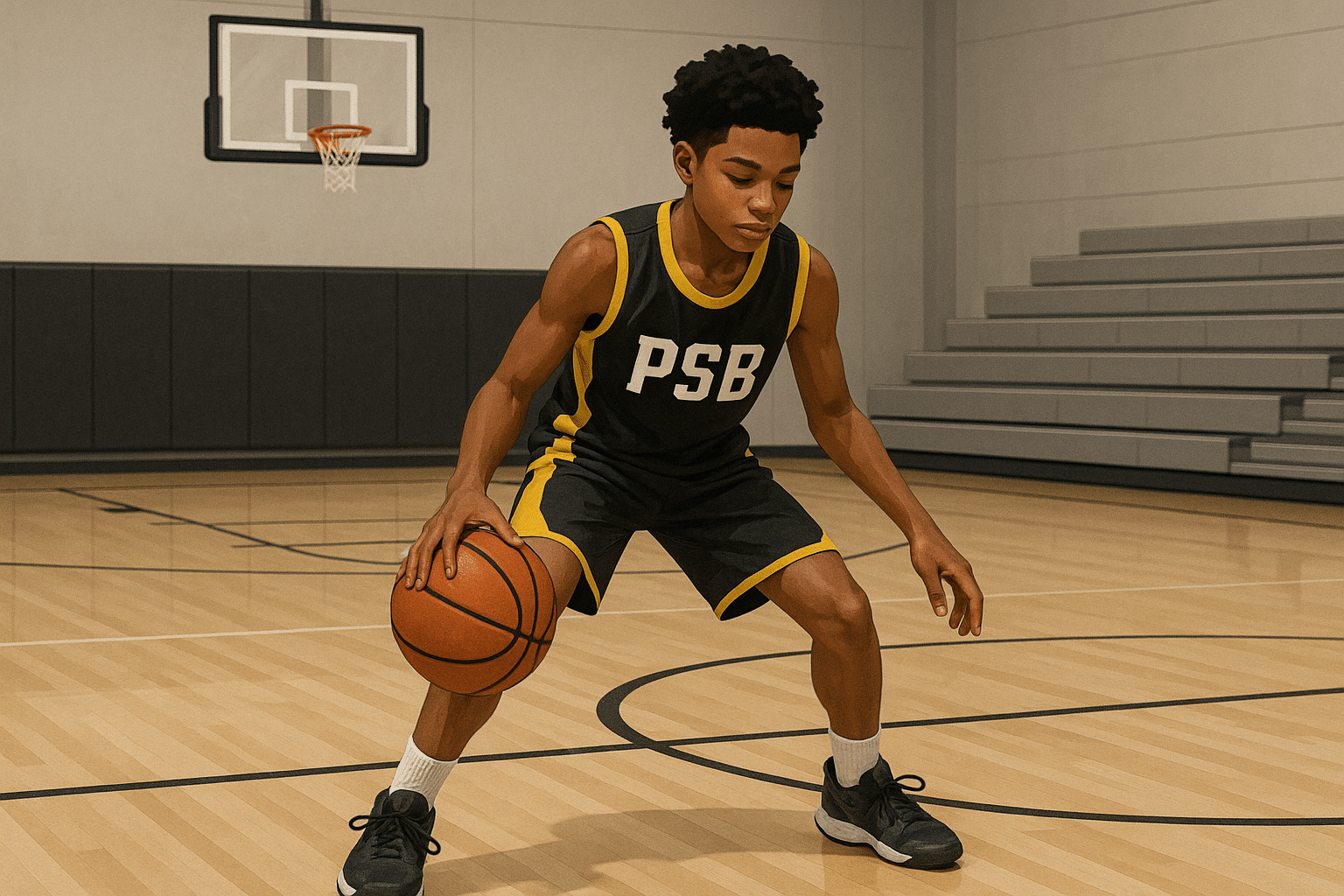
Run the six blocks in order, about 10 minutes each, with 60 to 90 seconds of water between them. Pick the intermediate or advanced track based on the player’s current level. A younger or newer guard can run intermediate across the board and still get a full, useful hour.
1. Ball handling and change of tempo
Modeled on Brunson, Haliburton, and SGA. Crafty hesitations, deceptive rhythm, control under pressure.
Intermediate:
- Walk-Run-Hesi: alternate slow dribbles with explosive bursts to train tempo changes, 3 reps each side.
- Cone snake dribbles: weave through cones using in-and-out, crossover, and spin, 3 sets.
- Stop-Skip-Change: dribble, stop on a dime, skip forward, crossover, 5 reps each side.
Advanced:
- Chaos handle: mix inside-out, stutter-step, and skip dribble in random order to simulate unpredictable changes.
- Live read: react to a partner’s hand signal (left = spin, right = cross, up = hesitation), then finish.
- Add a floater, mid-range pull-up, or finish after each rep.
2. Finishing and paint creativity
Modeled on SGA, Brunson, and Edwards. Control, contact balance, wrong-foot finishes, explosive takeoffs.
Intermediate:
- Wrong-foot, wrong-hand layups: right side off the left foot and the reverse, 3 sets each.
- Bump and finish: from the wing, bump a pad or chair, then finish off the glass.
- Floaters from an angle: dribble from the wing into the paint and float it off the glass, 5 reps each side.
Advanced:
- Euro into spin: one-dribble attack into a Eurostep, and if cut off, spin and reverse.
- Stop-fade-reset: stop at the block, up-fake, pivot, then finish or fade.
- Explosive finishes: start at the three-point line and attack full speed for a one-dribble strong finish through imaginary contact.
How do guards finish through contact?
Finishing through contact is where strength and balance matter most, and it is the skill young guards skip the most. The point is not to barrel into people. It is to stay on balance after a defender hits your body, so the shot still goes up cleanly. Block 4 is built entirely around that, and it pairs well with off-court work like our youth basketball strength drills.
“I just had to adjust to the athleticism that I was lacking by being crafty.”
— Kyrie Irving
3. Shot creation off the dribble
Modeled on Haliburton, Edwards, and SGA. Pull-ups, rhythm threes, hesitation jumpers, step-backs.
Intermediate:
- One-dribble pull-up series: catch, jab, take one dribble into a pull-up at the elbow, wing, and top, 3 reps each.
- Quick-trigger threes: simulate a late shot-clock pass and shoot with a minimal dip.
- Pound-dribble step-backs: hard pound, plant, step back, and shoot.
Advanced:
- Slow-down pull-up: walk in from half court, hesitate, then rise into a smooth pull-up, 5 reps.
- Step-back to re-attack: step back, fake, re-attack, then finish or shoot.
- Deep threes on the move: mix footwork (hop, 1-2, on the move) into longer-range shots.
4. Finishing through contact and body control
Modeled on Brunson and Edwards. Footwork mastery, controlled bump finishes, mid-air adjustments.
Intermediate:
- Push-dribble contact layup: push dribble from the wing and jump into resistance using a pad or band.
- Jump stops and pivots: jump stop in the paint, run a pivot series, then finish, 4 reps each.
- Reverse finishing series: use the rim as protection, both sides.
Advanced:
- Post-guard finishes: back down into a short hook or fade using only two dribbles.
- Euro into reverse bump: Euro from the wing, bump with the shoulder mid-air, then spin off the glass.
- Vertical-pop finishes: pop off one or two feet into a reverse or strong finish at the rim.
How do you train decision-making and pick-and-roll reads?
Scoring is only half of the guard job. The other half is reading what the defense gives and making the right play in real time. These reads are a habit you build with reps, the same way you build a handle. If your player wants to grow into a true lead guard, our breakdown of the traits great point guards share lines up directly with this block.
5. Decision-making and pick-and-roll reads
Modeled on Haliburton, Brunson, and SGA. Manipulating help, using screens, making live reads.
Intermediate:
- Pick-and-pop simulation: dribble off a cone screen, pass to an imaginary popper, relocate, then catch and shoot.
- Float or kick: attack from the top and make a read at the elbow, either a float or a kick pass, then relocate.
- Mid-range snake pull-ups: use the screen path to snake to the foul-line area for a pull-up.
Advanced:
- Two-read combo: after the screen, first read is score or pass; second read is the help defender arriving, so pull back or swing.
- Pocket pass or pull-up: if the roller is open, pass and relocate; if the defender sags, pull up.
- Random cue reaction: a partner signals shoot, drive, step back, or pass, and you react.
6. Freestyle scoring and conditioning
Modeled on all four guards. Unscripted creativity, conditioning, and confidence.
Intermediate:
- Three-combo finish: chain three different dribble moves into one drive and finish.
- Full-court change-of-tempo layups: jog to half court, then burst to finish, alternating hands each rep.
- 30-second shot generator: make as many shots as possible from random spots in 30 seconds.
Advanced:
- Create your bag: one minute to freestyle a combo from the top into a tough shot, staying unpredictable.
- Shot-clock conditioning: sprint corner to corner, receive a pass, and shoot with three seconds left.
- Five-move sequence: jab, attack, spin, step back, then relocate for a catch-and-shoot jumper.
Intermediate vs. advanced: which track fits your player?
Use this to choose a track for each block. A player can run intermediate on handle and finishing while pushing advanced on shooting if that is their strength.
| Factor | Intermediate | Advanced |
|---|---|---|
| Typical level | Middle school to early high school | Varsity, travel, or experienced players |
| Reps | Scripted, one skill at a time | Combined moves and live reads |
| Decision-making | Known cue, then execute | Random cue, react in real time |
| Goal | Clean mechanics and confidence | Game speed and unpredictability |
How often should a player run this workout?
Two or three times a week is plenty alongside team practice and games. Rotate the emphasis so the body and the mind both stay fresh: lean into handle and finishing one day, shooting and reads the next. Between sessions, a few easy reps from our at-home shooting workouts keep the stroke sharp without adding heavy load.
Frequently Asked Questions
What age is this guard workout for?
The intermediate track suits most players from middle school up. The advanced track fits high school and travel-level guards. Younger players should run intermediate and focus on clean form before adding speed or combinations.
Does a player need a partner or a full court?
No. Most blocks work solo with cones, a chair, and a ball. A partner helps with the live-read and random-cue drills, but a player can swap those for the scripted versions and still get a complete session.
How long does the full workout take?
About 60 to 70 minutes with short water breaks. If time is tight, run three blocks in one session and the other three the next day. The order is flexible as long as handle and finishing come before the heavier shooting and conditioning work.
Why model drills on specific NBA guards?
The names give a player a clear mental picture of the skill: a change of pace, a wrong-foot finish, a patient read. The goal is not to copy a player exactly but to borrow the habit and make it your own at your level.
Will skill work really help my child make a team?
Skill is one piece. With roughly 3.6% of high school boys basketball players reaching any NCAA division, the players who stand out tend to pair real skill habits with effort and good decisions. Consistent, focused reps like these build the kind of game that earns minutes. Our tryout tips cover the rest.
Sources

 How Basketball Players Develop at Their Own Pace