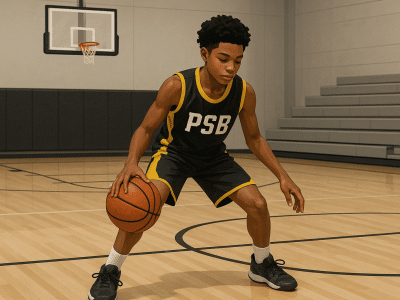
Game-like basketball workouts train players in the same conditions they face in real games: live reads, defenders, and game speed, rather than isolated repetition. Basketball is the most-played youth team sport in the United States, with about 41.9% of young athletes participating per the Aspen Institute. So habits built at game speed are what separate players on a crowded court.
Last updated: June 2026
Key Takeaways
- Game-like workouts pair skill repetition with live reads, defenders, and a clock so practice transfers to real games.
- Match the workout to your child’s stage: build habits first, add pressure next, then sharpen decision-making against high-level looks.
- Every rep should have a purpose, a target, or a consequence. Lazy reps teach lazy habits.
- Decision-making, not just shooting form, is what coaches notice when a player steps on the floor.
- You can run most of these workouts with a hoop, a ball, and one partner or parent.
What makes a basketball workout “game-like”?
A game-like workout adds the things a real game forces on a player: a defender to read, a clock running down, a teammate to find, and fatigue in the legs. Standing still and shooting 200 jumpers builds form. It does not teach a player what to do when a closeout flies at them with four seconds left. Game-like training closes that gap.
When you build situational context into a drill, a player develops four things that show up on game night:
- Basketball IQ: knowing when and why to use a skill, not just how.
- Game speed: getting comfortable making moves at the pace a real game demands.
- Decision-making under pressure: reading help defense, closeouts, and rotations in real time.
- Live conditioning: performing skills with tired legs, the way games actually feel.
Whether your child is new to the game or chasing a high school varsity spot, these workouts are built to challenge and prepare them. If shooting is the focus right now, pair these with our at-home shooting workouts for reps on off days.

What does a beginner game-like workout look like? (Grades 4 to 7)
At this stage, the goal is confidence and clean habits with light decision-making mixed in. Keep the energy high and the corrections simple.
Warm-up (5 minutes)
- Dynamic movement: arm circles, leg swings, high knees.
- Stationary ball handling: pound dribbles and crossovers.
Game-like drills (20 minutes)
- Partner passing with movement: pass on the move, relocate, catch again to mimic fast-break passing.
- 1-2 step layup reads: start on the wing and finish after one dribble with the correct hand based on an imaginary defender’s position.
- Catch-square-shoot: sprint to the wing, catch from a partner, square up, and shoot.
Mini games (10 minutes)
- 2-on-1 with a parent as defender: rewards spacing, passing, and the right layup decision.
- Free-throw routine: five makes in a row with the same dribble routine each time.
Coaching note: focus on doing every rep with intention, not just speed. For more options at this age, see our five best drills for youth players.
How do intermediate players add pressure and game speed? (Grades 7 to 10)
This level raises the pace and the complexity. Players should feel a little uncomfortable, because that is where growth happens.
Warm-up (5 minutes)
- Agility ladder plus dribble combinations.
- Closeout and backpedal footwork.
Game-like drills (25 minutes)
- Dribble decision reads: a cone or partner signals which hand to drive with after a crossover.
- One-dribble pull-up into rebound: catch, one hard dribble, shoot, then sprint to rebound.
- Drive, jump stop, kick: attack the middle from the top, jump stop, and pass to the wing to simulate a draw-and-kick.
- Transition finish: sprint from half court and use two dribbles max into a layup or pull-up.
Live situational play (10 minutes)
- 3-on-3 half court: the offense must score in 10 seconds, and the defense rotates after each possession.
Coaching note: add a small consequence, like three push-ups, for lazy reps or mental mistakes to build discipline. Learning to handle that pressure on purpose is a skill of its own; we cover it in how to compete in basketball.
What advanced workouts prepare players for high-level competition? (Grades 9 to 12+)
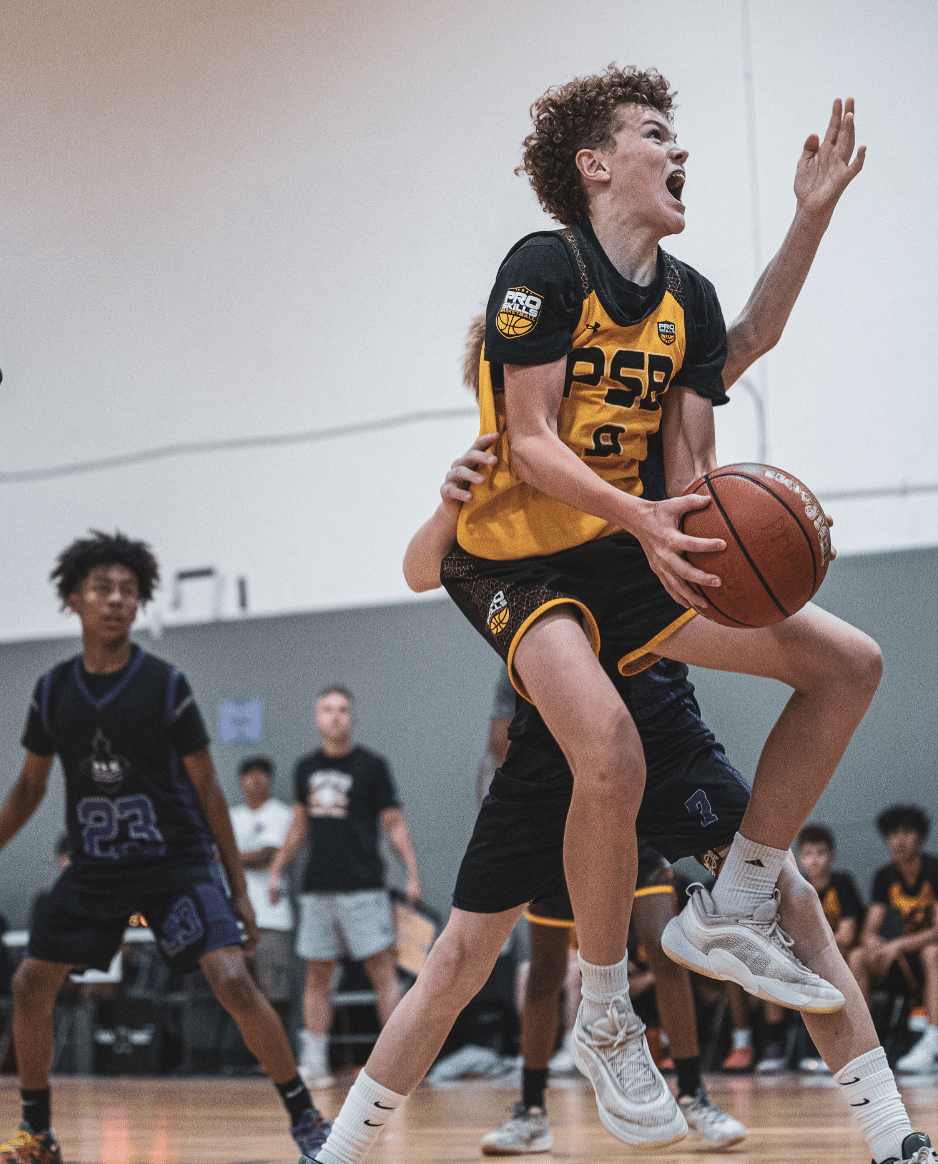
This level is built for players aiming at club rosters, varsity minutes, and possibly college recruitment. It is worth keeping the odds in view. According to the NCAA, roughly 3.6% of high school boys basketball players go on to play at any NCAA division, and about 1.1% reach Division I. The point is not to discourage your child. It is to train with the focus that level of competition rewards.
Warm-up (5 minutes)
- Resistance-band movement plus contact layups.
- Ball-screen footwork and pocket-pass reps.
Game-like drills (30 minutes)
- Game-winners series: five reps of one-on-one scoring with six seconds on the clock; the player must make three of five to win.
- Pick-and-roll reads: a coach shows hedge, drop, or switch, and the player makes the right read (pull-up, floater, or pass).
- Off-ball relocation shooting: sprint off a screen, then catch and shoot or relocate again based on the cue.
- Weak-side reaction: start weak side, react to a drive, and either catch-and-shoot or attack a closeout.
Conditioning and mental toughness (10 minutes)
- Make three in a row from three spots, or sprint sideline to sideline.
- Finish with five consecutive free throws; a miss resets the count.
Coaching note: build in self-reflection. Ask your child what worked and what did not during live reps. Players targeting the next level can also read our guide on what college basketball coaches look for in recruits.
How are game-like workouts different from regular drills?
| Feature | Standard drill | Game-like workout |
|---|---|---|
| Defender | None or imagined | Live read or cue to react to |
| Pace | Controlled, self-set | Game speed with a clock |
| Decision | Predetermined | Made in the moment |
| Conditioning | Separate from skill work | Built into the reps |
| Carryover to games | Limited | Direct |
Both have a place. Standard drills build the form and footwork that game-like reps then put under fire. The mistake is living only in the first column.
“You don’t get here by just wishing.”
— Pete Maravich, Basketball Hall of Famer
Maravich was famous for training at game intensity for hours as a young player, alone in the gym and against anyone who would guard him. The point holds for your child: skills earned at game speed are the ones that hold up when the game is real.
Frequently Asked Questions
How often should my child do game-like workouts?
Two to four focused sessions a week is plenty for most young players, with rest days in between. Quality beats volume. A sharp 45-minute session with real intent will do more than two distracted hours. Keep an eye on total load to help prevent overuse injuries.
Can these workouts be done at home without a full court?
Yes. Most of these drills need only a hoop, a ball, and one partner or parent to act as a defender or passer. A driveway or a single half court covers the beginner and intermediate work. The advanced reads benefit from a coach, which is one reason structured team training adds value.
At what age should a player start game-like training?
Around grades 4 to 7, a player can begin with the light-decision versions described above. Younger children should keep building basic ball handling and movement first. The decision-making layer is added gradually as comfort and coordination grow.
How do I know if a workout is actually game-like?
Ask one question: does the rep force a read, a clock, or a defender? If the answer is no, it is a form drill, which is fine in its place. If the answer is yes, your child is practicing the way they will have to perform.
Will game-like workouts help my child make a school team?
They directly target what coaches evaluate at tryouts: decisions, motor, and finishing under pressure rather than warm-up shooting. Pair this training with our tryout tips for the full picture.
Sources

By Brendan Winters, Co-Founder and Chief Growth Officer
Brendan co-founded Pro Skills Basketball in 2009 and is its Chief Growth Officer. At Davidson College he was a two-time All-American and Southern Conference Player of the Year. He then played five pro seasons in France, Germany, Hungary and Greece.

 What Basketball Really Teaches Young Players